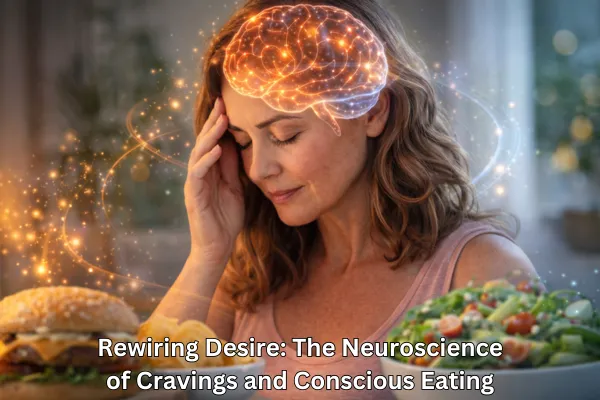
Rewiring Desire: The Neuroscience of Cravings and Conscious Eating
Many people struggling with weight describe cravings as if they appear out of nowhere.
One moment you feel calm and focused on your intentions. The next moment a strong urge for sugar, snacks or comfort food seems to take over.
It can feel confusing and frustrating, especially when you genuinely want to make healthier choices.
What neuroscience reveals is that cravings are not simply about discipline. They are often the result of deeply wired reward pathways in the brain.
Understanding how these pathways work can help explain why certain eating patterns feel automatic and how they can gradually be reshaped.
The Brain's Reward System
At the center of many cravings is a chemical messenger called dopamine.
Dopamine plays a key role in motivation, pleasure and learning. When we eat foods that are high in sugar, salt or fat, the brain releases dopamine as part of the reward response.
This response is not inherently negative. It is part of how humans learn which experiences are beneficial for survival.
However, modern processed foods are often designed to stimulate the reward system very strongly. When this happens repeatedly, the brain begins to associate certain foods with powerful feelings of relief or pleasure.
Over time these associations can form automatic habit loops.
Habit Loops and Learned Patterns
The brain is constantly looking for ways to conserve energy.
One way it does this is by turning repeated behaviors into habits. Once a behavior becomes a habit, the brain can perform it with very little conscious effort.
For example, if someone frequently eats sugary foods during stressful moments, the brain may begin to link stress with that reward. Eventually the craving itself can appear automatically whenever stress arises.
This is not weakness. It is the brain performing exactly as it was designed to do.
Recognizing these patterns allows us to approach change with curiosity rather than self-criticism.
Stress, Survival and Emotional Eating
The brain's reward pathways are closely connected to the nervous system's stress response.
When stress levels rise, the brain may seek quick sources of comfort or energy. Foods that are high in sugar or refined carbohydrates can temporarily increase dopamine levels, creating a brief sense of relief.
This is why emotional eating often appears during periods of overwhelm, fatigue or uncertainty.
The brain is attempting to regulate stress using the tools it knows will work quickly.
Developing new strategies for calming the nervous system can gradually weaken this cycle.
Neuroplasticity: The Brain's Ability to Change
One of the most hopeful discoveries in neuroscience is the concept of neuroplasticity.
Neuroplasticity refers to the brain's ability to reorganize itself by forming new neural connections. Habits that were once automatic can gradually be replaced with new patterns when different behaviors are repeated consistently.
This process does not require perfection. It requires repetition and patience.
Each time a person pauses before reacting to a craving, they create a small opportunity for the brain to form a new pathway.
Over time these small changes accumulate.
Mindfulness and Conscious Eating
Practices such as mindfulness and breath awareness can support this process of neural rewiring.
Mindfulness slows down the automatic reaction between craving and action. Even a brief pause allows the thinking part of the brain to become involved again.
Instead of reacting immediately, a person can observe the craving, notice how it feels in the body and decide how to respond.
This shift from automatic behavior to conscious awareness is often the first step in changing long-standing patterns.
The Gut-Brain Connection in Cravings
Cravings are also influenced by signals coming from the gut.
The microbiome produces chemical messengers that interact with the brain's reward pathways. When the gut ecosystem becomes imbalanced, these signals can sometimes amplify cravings for certain foods.
Supporting gut health through fiber-rich foods and microbial diversity can therefore influence both digestion and brain chemistry.
This is why metabolic health is best understood as a conversation between multiple systems rather than a single behavioral issue.
Building New Neural Pathways
Changing eating habits does not usually happen through force.
Instead, it emerges gradually as the brain learns new associations. When supportive routines such as balanced meals, stress regulation and mindful pauses are repeated, the brain begins to adapt.
What once felt like a powerful craving can slowly become a quieter signal.
This process takes time, but it reflects the remarkable adaptability of the human brain.
What’s Next?
In the modern wellness world, many people try to optimize their health through constant tracking, measurement and perfectionism.
Yet excessive monitoring can sometimes increase stress and disconnect us from our body's natural signals.
In the next article we explore how over-optimization can disrupt metabolic flow and how returning to intuition can support healthier balance.
Continue reading:
The Wellness Trap: When Tracking, Restriction and Metrics Disrupt Metabolic Flow
Introducing the Weight Wisdom Path
The Weight Wisdom path is a gentle, integrative approach to weight transformation.
It is educational, reflective, and grounded in both lived experience and research. It explores weight through multiple lenses, including emotional patterns, identity, feeling, stress, environment, and physiology.
We do not believe there is one right way to eat or move. We believe there is a right way to relate to your body.
This path does not ask you to disconnect from yourself in order to change. It asks you to reconnect so that change becomes possible.
Throughout this series, we will explore the deeper reasons weight struggles persist, and how a conscious, feeling-led approach can create lasting transformation without force or shame.
Other Articles Available
The Sacred Gut: How Your Microbiome Shapes Cravings, Mood & Metabolism
The Night Reset: Why Sleep is the Foundation of Weight Regulation
A Note on Health and Medical Care
This content is educational in nature and reflects my opinions based on experience, research, and observation. If you have medical concerns or conditions related to weight, appetite, or metabolism, I encourage you to consult with a qualified healthcare professional.
Weight Wisdom is not a replacement for medical care. It is an additional lens through which to understand your experience more fully.


